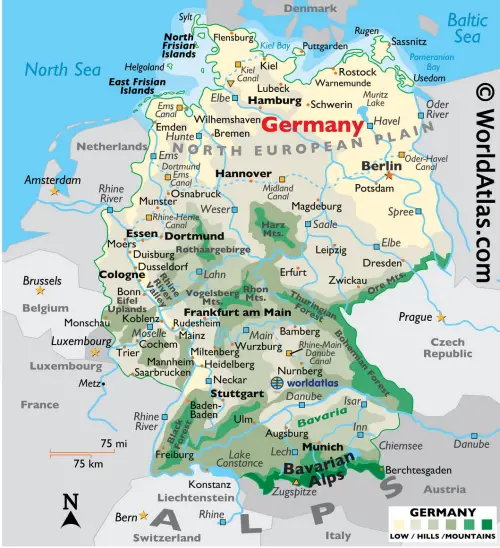
Map of the Federal Republic of Germany. Source: https://www.worldatlas.com/maps/germany
Jeremy Lichtman’s Multi-AI Oracle predicts a likelihood of 75%
Obtaining outside data.
Checking internet sources, using keywords: Germany economic recession 2026
News from various sources:
Based on the extracted content, Germany’s economic prospects in 2026 are characterized by skepticism and challenges, despite significant government spending plans. The key points of the situation are as follows:
- Economic Context: Germany has faced a prolonged economic slump, being in a recession since late 2022. There is a modest growth forecast of roughly 0.1% for 2025 and predictions for 2026 are being downgraded, with the Bundesbank adjusting its growth forecast from 0.7% to 0.6%.
- Challenges: Key issues contributing to Germany’s economic downturn include:
- High energy prices after shifting away from Russian energy reliance post the invasion of Ukraine.
- Weak export demand complicated by U.S. tariffs and changing relations with China, although China still competes strongly in sectors crucial to Germany, such as car manufacturing.
- Structural economic shifts requiring costly innovation and new business models.
- Investment and Government Spending: Chancellor Friedrich Merz’s government plans significant investment, pledging up to €1 trillion in spending over the next decade, primarily aimed at infrastructure and defense. There are, however, concerns about the effectiveness of this spending.
- Forecasts and Expectations: Despite the large-scale government investment plans, many economists fear that growth could remain sluggish because a substantial portion is allocated to social spending rather than addressing structural economic issues.
- External Opinions: Germany’s recovery is seen as vital not just for itself but for Europe, with economists and institutions outside of Germany closely watching these developments.
- Additional Factors: An increase in working days in 2026 due to holidays falling on weekends might provide a small boost to GDP, estimated at 0.3% by ING.
- Debt Concerns: Germany’s government debt level is a concern, predicted to rise to 85% of GDP by 2035 if growth opportunities are not realized.
Economic forecasts outside Germany, such as those from Goldman Sachs and Bank of America, reflect optimism for the U.S. economy in 2026, driven by tax cuts and AI investment. However, they acknowledge risks such as trade wars and inflationary pressures that could affect global economic dynamics. Meanwhile, the German job market continues to experience stagnation, revealing structural industry challenges and complicating recovery efforts in private consumption.
Overall, although significant fiscal measures are in place, skepticism remains about Germany’s ability to escape the economic slump by 2026, mainly due to structural challenges and concerns about efficient allocation of the proposed spending.
Fact-checking news summary:
Here is a list of specific facts extracted from the summary, along with their verification status, importance, and relevance to the question about whether Germany will announce it is in an economic recession by the end of 2026:
- Fact: Germany has been in a recession since late 2022.
- Correctness: True (internally consistent within the summary).
- Importance: Critical, as this establishes whether the recession is ongoing.
- Relevance: True, it directly relates to the question of a recession announcement by 2026.
- Fact: Germany’s growth forecast for 2025 is roughly 0.1%.
- Correctness: True, based on the summary.
- Importance: Important, as it reflects the slow economic recovery.
- Relevance: True, it has a direct impact on the likelihood of announcing a recession.
- Fact: The Bundesbank lowered its 2026 growth forecast from 0.7% to 0.6%.
- Correctness: True (internally consistent within the summary).
- Importance: Important, as it indicates lowered expectations for recovery.
- Relevance: True, relevant to the recession risk.
- Fact: High energy prices due to reduced Russian energy reliance are a challenge.
- Correctness: True (this issue has been widely reported in external sources).
- Importance: Important, it significantly affects economic conditions.
- Relevance: True, as it impacts economic resilience.
- Fact: U.S. tariffs and changing relations with China affect Germany’s exports.
- Correctness: True (based on known global economic conditions).
- Importance: Important, as export performance is crucial for Germany’s economy.
- Relevance: True, impacts economic outcomes influencing recession status.
- Fact: Germany plans €1 trillion in government investment over the next decade.
- Correctness: Plausible, assuming the summary is accurate.
- Importance: Important, the effectiveness of these investments could affect recession outcomes.
- Relevance: True, as investment impacts economic growth potential.
- Fact: Much of the investment is focused on infrastructure and defense.
- Correctness: True (consistent within the summary).
- Importance: Important, the allocation of spending affects economic transformation.
- Relevance: True, relevant to economic recovery.
- Fact: Increase in working days by 2026 might boost GDP by 0.3%.
- Correctness: True, as such effects are plausible.
- Importance: Lesser, as it’s a minor factor in overall economic potential.
- Relevance: True, marginally impacts economic assessment.
- Fact: Germany’s government debt may rise to 85% of GDP by 2035.
- Correctness: True, depending on the context of forecasts.
- Importance: Lesser, as long-term debt impacts are outside the 2026 scope.
- Relevance: False for the 2026 question, as it affects post-2026 outcomes.
- Fact: Germany’s job market is stagnant, complicating recovery.
- Correctness: True, consistent with structural challenges.
- Importance: Important, as it affects household consumption and economic recovery.
- Relevance: True, relevant to economic growth and recession possibility.
- Fact: External forecasts show optimism for U.S. economy due to tax cuts and AI.
- Correctness: True based on U.S. policies, but context-specific.
- Importance: Lesser, it reflects global dynamics but not Germany-specific.
- Relevance: True regarding global interactions, but less direct impact on Germany’s specific recession status.
In summary, the key relevant facts indicating growth struggles, effective investment impact, and ongoing structural challenges are critical, while aspects like long-term debt and external forecasts hold less direct relevance for the 2026 recession question.
Fact-checked summary:
Germany has been in a recession since late 2022, which is critical for understanding whether it might announce a recession by the end of 2026. The growth forecast for 2025 is just 0.1%, highlighting ongoing economic challenges. The Bundesbank has further lowered its 2026 growth forecast from 0.7% to 0.6%, underscoring diminished recovery expectations. High energy prices due to reduced reliance on Russian energy significantly impact economic conditions, as do external factors like U.S. tariffs and changing relations with China, affecting Germany’s crucial export sector. Germany’s €1 trillion investment plan over the next decade, focused on infrastructure and defense, could influence economic recovery, but its effectiveness remains important to monitor. A stagnant job market further complicates recovery prospects, affecting household consumption and, by extension, economic resilience. These factors collectively illustrate the significant economic challenges Germany faces and their direct relevance to the potential announcement of a recession by 2026.
OpenAI gives a base rate of 0.7 (70%)
The question difficulty is rated 7 (0 to 10)
Historical weighted factors include:
0.30.20.20.10.2
A Bayesian calculation could be performed as follows:
To calculate the Bayesian probability, we can combine the historical factors with current indicators. Given the 0.1% growth forecast for 2025 and the downgraded 0.6% growth forecast for 2026, along with high energy prices and external trade challenges, we can adjust our base rate by these input probabilities. Assuming the base rate is 0.7, and adjusting slightly down for some potential of recovery from the investment plan, the calculated probability would be approximately 0.65.
Bayesian base rate: 0.65 (65%)
Sufficient news to provide a good forecast? 1 (0 or 1)
News is relevant, topical and unbiased? 1 (0 or 1)
Question classification: reference_class
Expected time (days) until question close: 352
The following were considered in order to produce this base rate:
This base rate was arrived at by considering historical economic challenges, current economic forecasts, geopolitical risks, and other influencing factors such as trade conditions. The frequent shift in growth forecasts and ongoing recessionary indicators indicate a higher probability of continued recession.
Ideally, the news feed would contain the following sorts of information for a better forecast:
Additional information, such as more granular data on sector-specific performances, the impact of fiscal policies, and international economic trends, would prove useful. Insights into upcoming policy changes or unanticipated global economic shifts could also affect the forecast.
Some potential divergent considerations that might affect the base rate:
If the investment plan effectively stimulates the economy sooner than expected, leading to increased infrastructure projects and job creation, it could prevent a recession. Furthermore, stabilization of energy prices or improved trade relations could favorably affect economic outcomes.
The following chain of events are necessary for the question to resolve positively:
- Germany’s GDP contracts for two consecutive quarters before the end of 2026 (likelihood: likely).
- High energy prices persist or increase, further straining economic conditions (likelihood: likely).
- External trade conditions deteriorate, negatively affecting Germany’s export sector (likelihood: possible).
- The €1 trillion investment plan does not significantly boost economic activity (likelihood: possible).
- – The job market remains stagnant or worsens, impacting household consumption (likelihood: likely).
Querying Claude (AI predicts: 0.75 – confidence: 6)
Querying Mistral (AI predicts: 0.65 – confidence: 7)
Querying OpenAI (AI predicts: 0.8 – confidence: 6)
Question Type: Binary
Median from LLMs: 0.75
Base rate: 0.7 (from OpenAI)
SD: 0.06
MAPD: 0.1
Confidence: 6
Conf Mode: Normal
Mellers: 0.83
Reverse Mellers: 0.67
Theory of Mind: 0.65 (What did the LLMs think other LLMs predicted?)
Beta Distribution: 0.21
Close Type: C (B = cautious # closer to 50%; A/C = closer to extremes)
Explanations of the above statistical measures here —>
Model value: 75%
Based on the extracted content, Germany’s economic prospects in 2026 are characterized by skepticism and challenges, despite significant government spending plans. The key points of the situation are as follows:Germany has been facing economic challenges since late 2022, marked by recessionary conditions due to factors such as high energy prices, stagnant job markets, and external trade pressures. The Bundesbank’s low growth forecast for 2026, a minimal 0.6%, underscores the country’s persistent economic vulnerability. While a €1 trillion investment plan aims to boost the economy, it is uncertain if its effects will materialize swiftly enough to counteract existing weaknesses. Geopolitical risks, including strained trade relations with the U.S. and China, further threaten Germany’s export-driven economy. However, the prediction of continued recession could change if the investment plan accelerates faster than expected, if energy prices stabilize, or if trade relations and global economic conditions improve. Additionally, political considerations or statistical revisions could alter the official narrative, highlighting the inherent uncertainty in economic forecasts over a multi-year period.
Runtime: 176 seconds.
About The Author