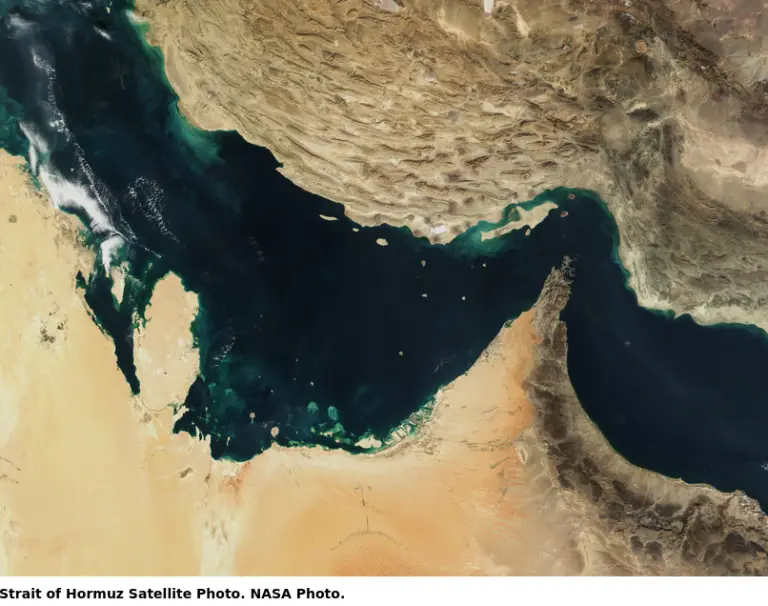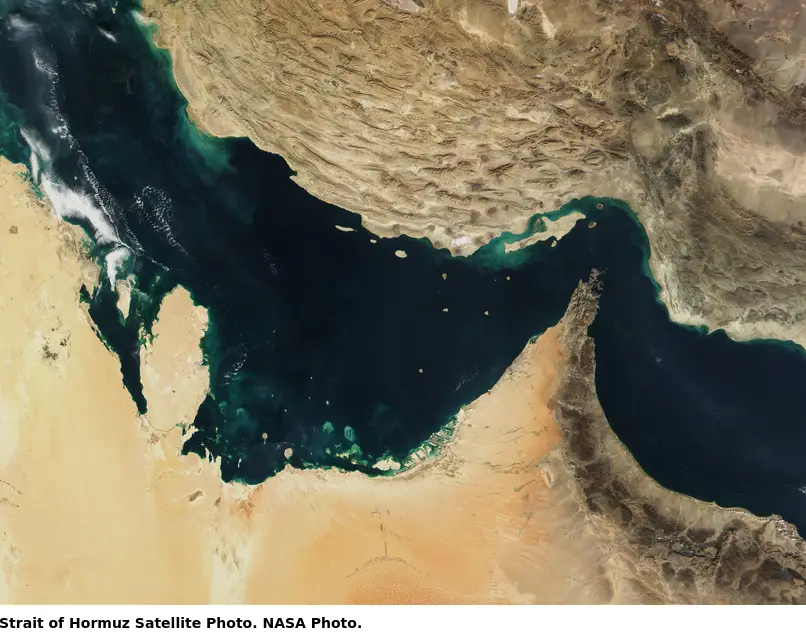
Strait of Hormuz satellite photo. Source: NASA
Phillip Godzin’s pgodzinai forecasts 45%
This is the condensed report. Full version here.
Grok response:
- Title: Shipping Has Collapsed Through Vital Strait of Hormuz
Description: Bloomberg article on near standstill of traffic amid US-Israel-Iran war.
Date of Publication: March 4, 2026 (22 hours ago from March 5).
Summary: Traffic through the Strait has plummeted by over 95%, with only two bulk carriers and one small container ship observed on Tuesday, all outbound. Major crude carriers and LNG tankers are avoiding the route entirely. Ship-tracking data shows just seven vessels passed on Monday, down from over 100 on Friday before strikes began.[1] - Title: Strait of Hormuz: How Iran Conflict Is Disrupting Oil and Gas Shipping
Description: Bloomberg report on maritime traffic halt post-US/Israel strikes.
Date of Publication: March 4, 2026.
Summary: Traffic has almost completely stopped since strikes on Iran, with IRGC warning ships of missile/drone risks. Insurers have withdrawn war risk coverage for the area. No significant LNG or oil tanker transits reported in recent days.[2] - Title: Iran War Brings Strait of Hormuz Traffic to a Halt
Description: Bloomberg evening briefing on fifth day of war and shipping stoppage.
Date of Publication: March 5, 2026 (2 hours ago).
Summary: By day five of conflict, shipping has effectively stopped; a container vessel was attacked and abandoned in the strait. Fears realized of Hormuz as battlefield chokepoint. No resumption of LNG or major tanker flows noted.[3] - Title: Iran conflict 2026: Disruption to Strait of Hormuz increases energy risks
Description: Janes analysis of vessel passages decreasing amid conflict.
Date of Publication: March 2, 2026.
Summary: By March 2, vessel passages had substantially decreased, widening disruptions to global oil and LNG. Qatar, a top LNG exporter, routes nearly all through the strait. Ongoing war escalations prevent any traffic normalization.[4] - Title: The global chokepoint in the Strait of Hormuz
Description: Reuters graphic on oil/LNG flows through Hormuz.
Date of Publication: March 2, 2026.
Summary: Qatar sends almost all LNG through the strait, now disrupted by war. Traffic data shows sharp decline in transits. No reports of LNG carriers resuming unimpeded passage.[5] - Title: Oil surges as Strait of Hormuz traffic nearly halts amid Middle East war
Description: World Oil coverage of oil price gains due to traffic halt.
Date of Publication: March 2, 2026.
Summary: Traffic nearly halted, with largest single-day oil gain. LNG traffic similarly impacted, no resumption. Conflict ongoing with no signs of reopening.[6] - Title: Strait of Hormuz Disruptions Raise Shipping and Infrastructure Concerns
Description: Pipeline & Gas Journal on slowing crude/LNG traffic.
Date of Publication: March 2, 2026.
Summary: Tensions slowing ~20% of global oil and LNG flows. Escalations prevent unimpeded transits. Vessels avoiding strait entirely.[7] - Title: How Iran’s Strait of Hormuz shutdown could hit the global economy
Description: Axios on economic impacts of shutdown.As of March 5, 2026, the Strait of Hormuz is effectively closed to LNG traffic following the outbreak of a US-Israel-Iran war beginning around February 28, 2026
Date of Publication: March 5, 2026 (13 hours ago).
Summary: US-Israel war with Iran escalates tensions, leading to shutdown. Global energy trade disrupted, including LNG. No movement toward reopening reported.[8] - Title: Iran has largely halted oil and gas exports through strait of Hormuz
Description: Guardian report on halted exports and tanker strikes.
Date of Publication: March 4, 2026.
Summary: Iran halted exports; at least four tankers struck by drones. Maritime traffic down sharply, including LNG. No resumption as of latest updates.[9] - Title: 2026 Strait of Hormuz crisis
Description: Wikipedia entry on ongoing crisis since Feb 28.
Date of Publication: March 5, 2026 (last edited 3 hours ago).
Summary: Geopolitical disruption since Feb 28; traffic heavy outgoing on 28th but light incoming. Tankers struck; effective de facto closure. No reports of LNG resumption by early March.[10]
Current Status and Recent Developments
As of March 5, 2026, the Strait of Hormuz remains effectively closed to commercial LNG traffic due to the ongoing US-Israel-Iran war that began with strikes on Iran around February 28, 2026.[1][3] Ship-tracking data from Bloomberg indicates traffic has dropped over 95%, with zero major LNG carriers or crude tankers transiting since late February; only minimal non-energy vessels (e.g., two bulk carriers outbound on March 4) have been observed.[1][2] Over 150 oil tankers and LNG vessels are anchored inside the Persian Gulf, unable to exit unimpeded.[11]
Key factors sustaining the halt include: Iranian IRGC VHF warnings to ships, drone/missile strikes on at least four tankers and a container vessel (now abandoned in the strait), withdrawal of war risk insurance by seven major P&I clubs, and suspensions by carriers like Maersk, Hapag-Lloyd, MSC, and others.[2][12] Qatar, responsible for ~20% of global LNG exports (all via Hormuz), has halted production and shipments.[13] No major news outlets report any resumption or unimpeded LNG carrier transits as of today.
Impacts and Data
- Traffic Statistics (Recent): Pre-conflict (Feb 27): >100 vessels/day. Feb 28: Heavy outgoing, light incoming. March 1-2: 60-70% drop, 72 vessels (mostly pre-suspension). March 3-4: Down 94-95%, <10 vessels total, zero LNG/crude. March 5: Near standstill confirmed.[1][14]
- LNG-Specific: Nine+ LNG carriers diverted course early March; Qatar LNG flows at risk, contributing to gas price spikes in Europe/Asia.[15][16]
- Economic Signals: Oil up 7%+ to $72/bbl post-attacks; European gas rallied 50%+ before partial pullback.[17][18]
Expert and Official Views
China urging Iran to keep open for its imports; no diplomatic breakthroughs reported.[20]
No authoritative resolution source (e.g., specific tracker) beyond major outlets like Bloomberg/Reuters, which confirm ongoing halt with daily updates through March 5.[1] Recent updates show intensification (e.g., US sub sinking Iranian ship, refinery hits), not movement toward reopening.[21]
Bloomberg commodities experts note US military escorts/convoys needed for resumption, but “won’t fix flows overnight” and could take weeks; no such operations active yet.[19]
US Central Command states strait “not closed” despite Iranian claims, but de facto blockade via insurance/avoidance persists.[13]
=== Forecast Result ===
Current Situation Assessment
As of March 5, 2026, the Strait of Hormuz is effectively closed to LNG traffic following the outbreak of a US-Israel-Iran war beginning around February 28, 2026. Key facts:
- Traffic has dropped over 95% with zero LNG carriers or major tankers transiting
- Multiple tankers attacked by drones/missiles; at least one container vessel abandoned
- War risk insurance withdrawn by seven major P&I clubs
- Over 150 oil tankers and LNG vessels stranded in the Persian Gulf
- Qatar (20% of global LNG exports, all via Hormuz) has halted shipments
- The conflict is only in its 5th day with no signs of resolution
Timeline Considerations
From today (March 5) to resolution (May 31): approximately 87 days or nearly 3 months
This is a substantial window for the situation to evolve. Factors affecting timeline:
Factors favoring reopening before May 31:
- Enormous global economic pressure (20% of global oil/LNG flows)
- US Navy committed to escorting tankers
- Insurance sources suggest ships could resume “by end of week” once negotiations complete
- China pressuring Iran to keep strait open
- Historical precedent: strait remained open even during Iran-Iraq war attacks
Factors working against reopening:
- Active war with no signs of de-escalation (actually intensifying per latest reports)
- “Unimpeded transit” is a high bar requiring essentially peacetime conditions
- Expert assessment that “market is overly optimistic about resumption”
- Bloomberg experts note convoys “won’t fix flows overnight” and could take weeks
- Insurance markets extremely reluctant in active conflict zones
Historical Base Rates
- Regional Middle East conflicts rarely resolve within weeks
- However, limited military operations (e.g., 1998 Desert Fox, 2020 Soleimani strike) can de-escalate relatively quickly
- Major shipping chokepoint crises (Suez 1956, 1967, 1973) varied widely in duration
Key Assumptions and Failure Probabilities
Assumption: The conflict will continue at current intensity for months
- Failure probability: ~35%
- International economic pressure is intense; diplomatic efforts ongoing
Assumption: “Unimpeded” requires full normalization, not just convoy traffic
- Failure probability: ~25%
- Resolution criteria says “resume or continue unimpeded transit” – if convoys count, probability increases
Assumption: Expert skepticism about quick reopening is accurate
- Failure probability: ~30%
- Markets sometimes see developments faster than experts predict
Probability Calculation
Scenario Analysis:
| Scenario | Probability | P(Reopen in scenario) | Contribution |
|---|---|---|---|
| Rapid de-escalation (within 3-4 weeks) | 15% | 85% | 12.8% |
| Moderate de-escalation (1-2 months) | 30% | 60% | 18.0% |
| Prolonged stalemate | 35% | 35% | 12.3% |
| Major escalation | 20% | 5% | 1.0% |
| Total | 44.1% |
Considerations for Calibration
- Expert skepticism (“overly optimistic”) suggests I should weight more conservatively
- 87 days is substantial time for change, but also substantial time for conflict to entrench
- The “unimpeded” criterion sets a high bar
- My historical tendency toward overconfidence suggests I should adjust downward slightly
Given the genuine uncertainty of an ongoing active conflict, the conflicting signals (strong incentives to reopen versus ongoing military action), and the high bar set by “unimpeded transit,” I estimate:
Probability: 45%
End
About The Author