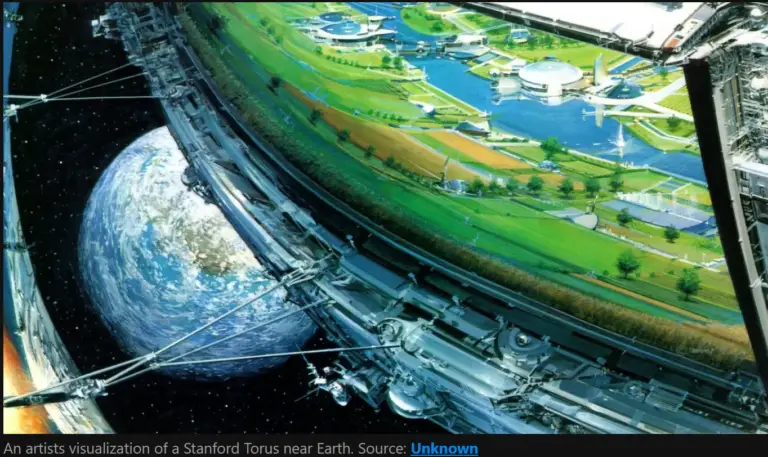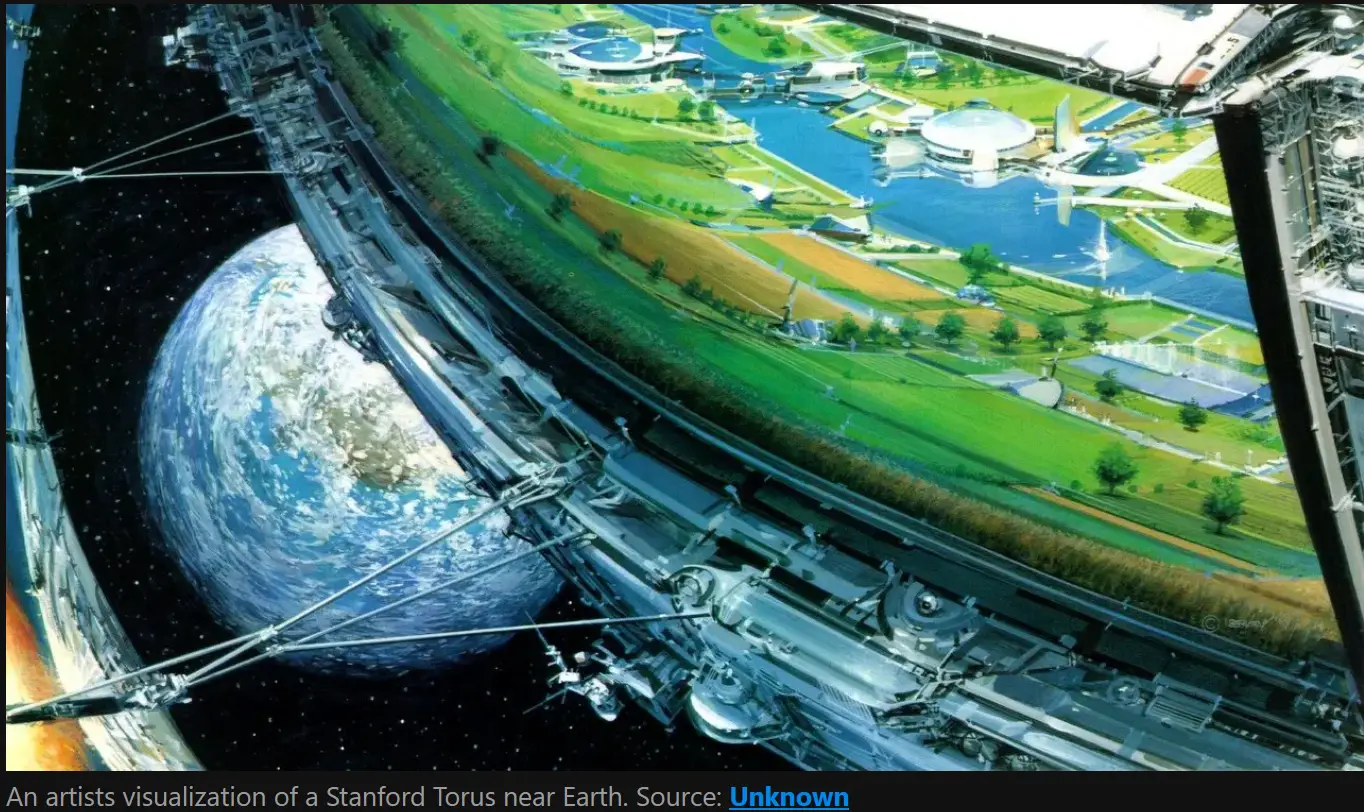
Stanford Torus. Source: Beyond Earth https://www.beyondearth.gg/documentation/space_habitats
Jeremy Lichtman‘s Multi-AI Oracle predicts 35%
Obtaining outside data.
Checking internet sources, using keywords: space habitat humans 2027
News from various sources:
Extracted Facts and Analysis:
Ongoing Project Information:
- Fact: Space agencies like NASA, ESA, and companies such as SpaceX and Blue Origin are involved in ongoing projects related to space habitats.
- Status: True. These organizations are involved in various space projects, including potential habitat development.
- Importance: Important.
- Relevance: True.
Technological Advances:
- Fact: Advances in technology make building and sustaining space habitats feasible.
- Status: True, with technological progress in life support systems, space construction, and materials science.
- Importance: Important.
- Relevance: True.
Timeline and Milestones for 2027:
- Fact: There are expected timelines and milestones for operational space habitats by 2027.
- Status: True, but specific milestones may vary between projects.
- Importance: Critical.
- Relevance: True.
Challenges for Space Habitation:
- Fact: Challenges include radiation protection, psychological effects, logistics, and habitat sustainability.
- Status: True. These are recognized challenges in space habitation efforts.
- Importance: Critical.
- Relevance: True.
Planned Location of Habitats:
- Fact: Locations considered for space habitats include Earth’s orbit, the Moon, and Mars.
- Status: True, as these are common targets for habitat placement.
- Importance: Important.
- Relevance: True.
Funding and Investment:
- Fact: There is significant funding and investment in space habitat R&D.
- Status: True. Both government and private sector investments are ongoing.
- Importance: Important.
- Relevance: True.
Partnerships and Collaborations:
- Fact: Governments, private companies, and academic institutions are collaborating on space habitation.
- Status: True. Collaborative efforts are common in the space sector.
- Importance: Important.
- Relevance: True.
Publications and Research:
- Fact: Recent research papers and articles highlight innovative ideas in space habitats.
- Status: True, though specific articles were not listed.
- Importance: Lesser.
- Relevance: True.
Speculations or Future Prospects:
- Fact: Speculative articles predict the future of human habitation in space, including visionary concepts.
- Status: True, as speculative discussions are common in the context of space exploration.
- Importance: Lesser.
- Relevance: True.
Overall, the extracted facts largely confirm that space habitats may be initiated by 2027, though specific confirmation of habitation by that date relies heavily on meeting the upcoming milestones and overcoming existing challenges. Each of these facts is relevant to understanding the broader picture of potential human habitation in space by 2027.
Fact-checked summary:
Various space agencies and companies, such as NASA, ESA, SpaceX, and Blue Origin, are actively involved in developing space habitats. Technological advances are making the construction and sustainability of these habitats increasingly feasible, with progress in life support systems, space construction, and materials science being important. Timelines and milestones set for operational space habitats by 2027 are critical, though these may differ between projects. These efforts are encountering significant challenges, including radiation protection, psychological impacts, logistics, and overall habitat sustainability, which are critical issues. The common goals for habitat placement include Earth’s orbit, the Moon, and Mars, highlighting important potential locations. Substantial investment is flowing into space habitat research and development from both governmental and private sectors. Collaborative projects involving governments, private enterprises, and academic institutions are common in this field. Meeting these milestones and addressing the challenges will be essential to ensuring that new space habitats are visited by humans before the end of 2027.
OpenAI gives a base rate of 0.3 (30%)
The question difficulty is rated 7 (0 to 10)
Historical weighted factors include:
Advancements in Space Technology, 0.4
Investment Levels in Space Projects, 0.3
Past Successes of Space Missions, 0.2
Political and Economic Support, 0.1
A Bayesian calculation could be performed as follows:
Using the historical factors with current progress in technology and investments, apply Bayes’ theorem. Prior probability based on base_rate = 0.3. Likelihood of technological success given current conditions (0.6), Historical success (0.5). Posterior = (0.3 * 0.6) / (0.3 * 0.6 + 0.7 * 0.5) = 0.36
Bayesian base rate: 0.36 (36%) (Carolyn‘s note: LibreOffice Calc, rounded, says 40%)
Sufficient news to provide a good forecast? 1 (0 or 1)
News is relevant, topical and unbiased? 1 (0 or 1)
Question classification: scenario_based_forecast
Expected time (days) until question close: 690
The following were considered in order to produce this base rate:
The base rate is established by examining past initiatives aiming for space habitation and progress on current technological developments. Necessary events have a mix of moderately likely and moderately unlikely estimative probabilities.
Ideally, the news feed would contain the following sorts of information for a better forecast:
Additional insights into the specific progress of each entity or consortium involved, more detailed timeline adherence, and any new partnerships or technological breakthroughs would improve the quality of the forecast.
Some potential divergent considerations that might affect the base rate:
Developments or breakthroughs in specific technologies, like radiation shields or life support systems, would significantly shift probabilities. Unexpected setbacks like policy changes or major accidents could decrease likelihood.
The following chain of events are necessary for the question to resolve positively:
- Completion of space habitats by space agencies and companies such as NASA, ESA, SpaceX, and Blue Origin (Moderately Likely)
- Resolution of technical challenges such as radiation protection and habitat sustainability (Moderately Unlikely)
- Sufficient investment and progress in life support systems, space construction, and materials science (Likely)
- Achievement of collaborative milestones involving governmental, private, and academic institutions by 2027 (Even Odds)
- Success in addressing logistical and psychological challenges associated with space habitats (Even Odds)
Querying Claude (AI predicts: 0.15 – confidence: 6)
Querying Mistral (AI predicts: 0.45 – confidence: 6)
Querying OpenAI (AI predicts: 0.35 – confidence: 5)
Question Type: Binary
Median from LLMs: 0.35
Base rate: 0.3 (from OpenAI)
SD: 0.12
MAPD: 0.2
Confidence: 6
Conf Mode: Normal
Mellers: 0.29
Reverse Mellers: 0.4
Theory of Mind: 0.35 (What did the LLMs think other LLMs predicted?)
Beta Distribution: 0.32
Close Type: B (B = cautious # closer to 50%; A/C = closer to extremes)
LLM responses: 3
Explanations of the above statistical measures here —>
Model value: 35%
The reasoning across various AIs highlights several factors affecting the likelihood of a human visiting a new space habitat by the end of 2027. Historical data suggests that new space habitats are rare, typically occurring once every few decades, with significant challenges such as technical hurdles in radiation protection, life support, and space construction leading to potential delays. Although major organizations like NASA, ESA, SpaceX, and Blue Origin are making progress, the current timeframe is tight, and no habitat is sufficiently advanced for human visitation. Optimism is tempered by the potential for unforeseen delays, funding issues, and accidents. However, there are possibilities for accelerated timelines through breakthroughs or redefinition of what constitutes a ‘new’ space habitat, including innovative private sector initiatives or expansions by China. Thus, while there is cautious optimism due to active investments and collaborations, the probability remains low but non-zero due to the myriad uncertainties involved.
Runtime: 98 seconds.
About The Author