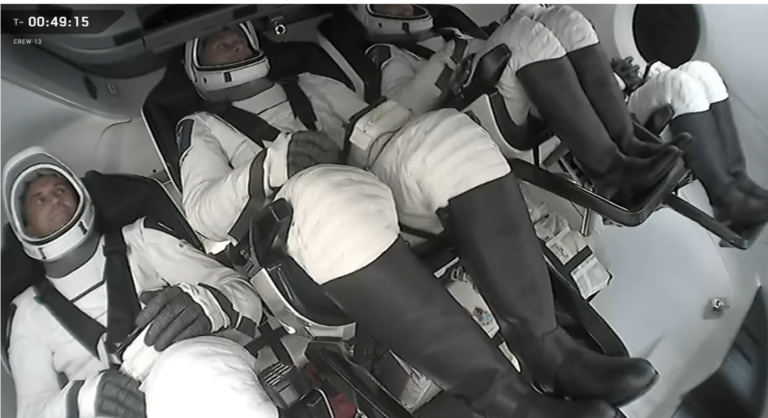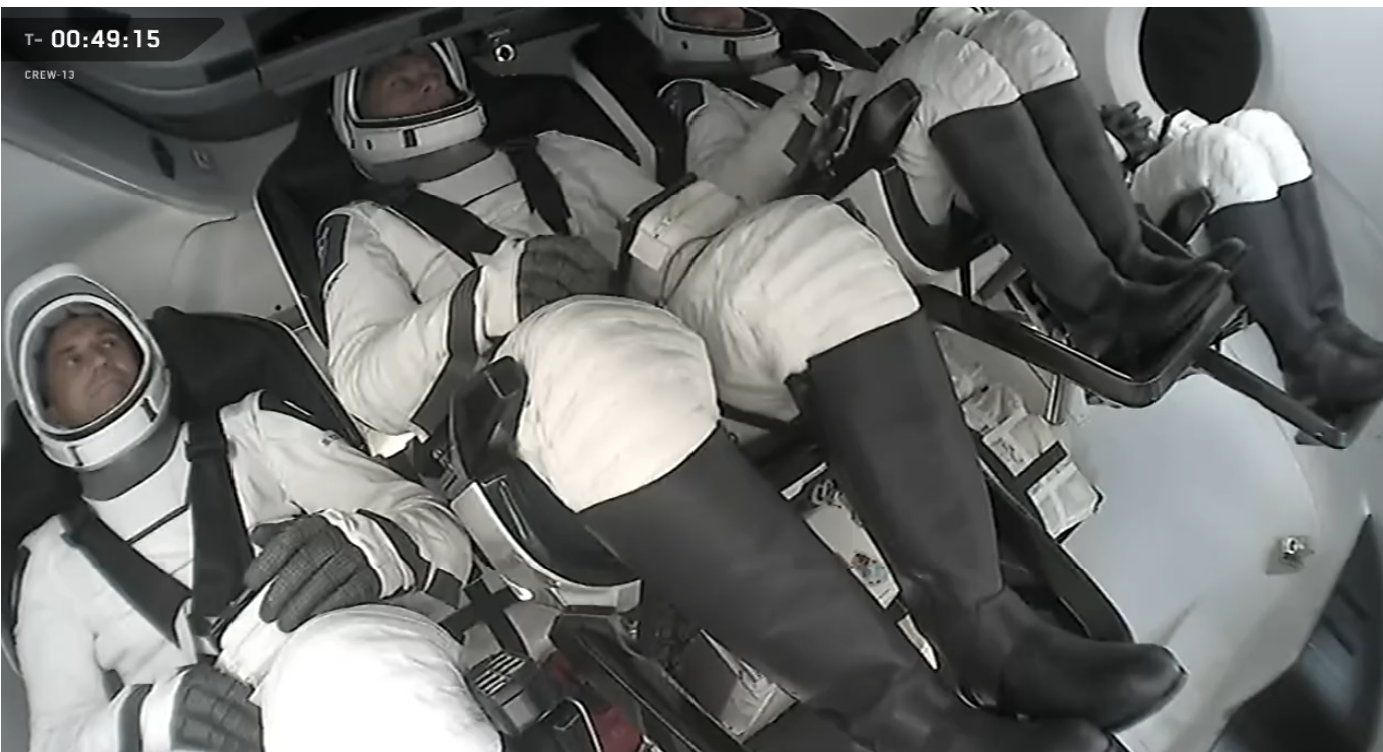
Screengrab: On Thursday, October 1 at 11:10 a.m. ET, Falcon 9 launched Dragon’s 13th operational human spaceflight mission (Crew-13) to the International Space Station from Space Launch Complex 40 (SLC-40) at Cape Canaveral Space Force Station. Dragon autonomously docked with the space station on Thursday, October 1 at 7:05 p.m. ET. The Dragon spacecraft supporting this mission previously flew the Ax-4, mission to and from the space station. This was the third flight for the first stage supporting this mission, which previously launched Crew-12 and one Starlink mission. Following stage separation, Falcon 9’s first stage landed on Landing Zone 40 (LZ-40) at Cape Canaveral Space Force Station. Source: https://www.spacex.com/launches/crew13
DeepSeek research response:
Bottom line
As of Nov. 25, 2026, no new space habitat has launched, let alone hosted humans. The question effectively reduces to one candidate: Vast’s Haven-1. Vast still targets a Q1 2027 uncrewed launch, with the first four-person Crew Dragon mission, Vast-1, planned for 2027. That gives a real but schedule-dependent path to a crewed visit before Dec. 31, 2027. Orbital Reef, Starlab and a Starship station are all materially further away.
The critical distinction is launch versus visit: Haven-1 launches without crew, then must pass uncrewed checkout, win SpaceX’s docking approval, and receive a separately launched Crew Dragon. A Q1 2027 launch leaves roughly nine months of margin; a slip to late 2027 would almost certainly push the first crew into 2028.
6 citations
1. “The first private-sector space station is due to go into orbit”
The Economist, The World Ahead 2027 — published Nov. 17, 2026
This essay states that a SpaceX Falcon 9 will launch Haven-1 in 2027, making it the first privately built and operated space station. It describes a 10.1 m by 4.4 m aluminium cylinder with 80 m³ of pressurized volume, a Crew Dragon docking port and capacity for four people. It says four two-week missions are planned but does not specify when the first crew arrives.
2. “The European Space Agency and Vast Build on Existing Mission Collaborations and Strengthen Cooperation on Post-ISS”
European Space Agency, press release No. 61–2026 — Oct. 5, 2026
ESA announced a new MoU with Vast at the 77th International Astronautical Congress covering potential European use of Haven stations. Vast CEO Max Haot is quoted saying ESA and Vast are collaborating on four crewed missions to the ISS and Haven-1 planned for 2027, including the first crewed mission to Haven-1. The release confirms French ESA reserve astronaut Arnaud Prost for a Haven-1 mission and frames the cooperation as preparation for the post-ISS era.
3. “Concerns Loom Amid Space Station Successor Program Delay”
Aviation Week — Oct. 5, 2026
Aviation Week reports that NASA’s CLD Phase 2 request for proposals has slipped while the agency reviews industry comments, leaving station operators uncertain about schedules, budgets and technical requirements. It flags that SpaceX’s Falcon 9 and Crew Dragon fleet are expected to withdraw as SpaceX transitions to Starship-Super Heavy, and that SpaceX has not said what crew role, if any, Starship would play. Blue Origin’s Orbital Reef program manager says the company has no plans to fund a crew vehicle internally, while Vast’s Max Haot calls assured crew transportation a national-security imperative.
4. “NASA’s Commercial LEO Destinations: How the Plan to Replace the ISS Changed”
Orbital Radar — updated Nov. 7, 2026
This tracker recounts how NASA’s Commercial LEO Destinations plan was rewritten between 2019 and 2026, including the March 2026 “Ignition” proposal and its June 2026 reversal. It says the final RFP was issued Oct. 9, 2026, guarantees at least $100 million and allows up to $34.06 billion in orders, with bids due Dec. 8, 2026 and awards expected in spring 2027. It concludes that “Vast’s Haven-1 is first in line to fly” and that NASA will decide in 2027 whether to keep the 2030 ISS retirement date.
5. “Vast’s Haven-1 continues to advance through milestones ahead of planned 2027 launch”
NASASpaceFlight.com — July 3, 2026
NASASpaceFlight reports that Haven-1 remained on track for a Q1 2027 Falcon 9 launch after June 2026 installation of thermal-control system trays and vacuum testing of a 10-kW Hall thruster. It says the inaugural four-person Vast-1 crew will arrive on Crew Dragon, which will also provide supplemental CO2 scrubbing, and that ESA reserve astronaut Arnaud Prost is expected to be flight engineer. It also notes UK Space Agency talks about flying John McFall to Haven-1.
6. “Roadmap”
Vast Space, official company page — accessed Nov. 25, 2026 (undated/current)
Vast’s official roadmap lists Haven-1 under 2027 as “targeted to be the world’s first commercial space station,” with 45 m³ habitable volume, 80 m³ pressurized volume and a crew of four. It places Haven-2’s first module in 2028 and a four-module Haven-2 in 2030. The page gives no month for launch and no date for the first crewed visit.
=== Forecast Result ===
=== Reasoning ===
Looking at this question, I need to assess whether any new space habitat (Haven-1, Orbital Reef, Starlab, or a Starship-based station) will be visited by humans before December 31, 2027.
Key considerations:
Haven-1 is the only credible near-term candidate. Orbital Reef lacks a crewed vehicle commitment and Blue Origin recently declined to bid in NASA’s procurement round. Starlab reporting has shifted toward 2028-2029, depends on an unflown Starship. A Starship-based NASA station remains conceptual with no crewed schedule.
Haven-1’s status as of Nov 25, 2026:
- Structure complete, integration ongoing since January 2026
- Thermal control and propulsion testing completed mid-2026
- Target remains Q1 2027 launch (uncrewed), reaffirmed as recently as September 2026
- ESA MoU (Oct 2026) explicitly references “first crewed mission to Haven-1” planned for 2027
- Named astronaut (Arnaud Prost), but 3 of 4 crew members remain unnamed
Critical risk factors:
- Program has already slipped ~3 times by roughly 9 months each (Aug 2025 → May 2026 → Q1 2027)
- No public confirmation that the critical Plum Brook environmental test campaign is complete
- Dragon docking certification is a separate, unresolved gating step — CEO himself cited a “two weeks to three years” range for first crewed visit post-launch
- SpaceX’s Dragon/Falcon 9 fleet transition toward Starship creates additional schedule uncertainty
- No confirmed launch date (month) has been publicly announced, only “Q1 2027” target language
Timing math: Even if Haven-1 launches on schedule in Q1 2027, there’s ~9 months of buffer before the Dec 31, 2027 deadline — meaningful margin. But if launch slips to Q3/Q4 2027 (plausible given slip history), the crewed visit likely pushes into 2028.
Assumptions most likely to be wrong and impactful:
- That Q1 2027 launch target holds (vs. further slip) — moderate probability of failure (~40-50%)
- That crewed visit follows launch within months rather than being delayed by certification/training issues — meaningful uncertainty here too
- That no other candidate accelerates unexpectedly — low probability but adds a small positive tail
Weighing the genuine program maturity and multiple positive signals (ESA partnership, named astronaut, continued “on track” reporting through November 2026) against the well-documented historical slip pattern and the explicit CEO-acknowledged uncertainty in the launch-to-crew gap, I estimate this as roughly a coin-flip with slight positive lean, tempered by general calibration caution against optimistic aerospace timelines.
Data sufficiency: Sufficient
Probability: 45%
End
About The Author