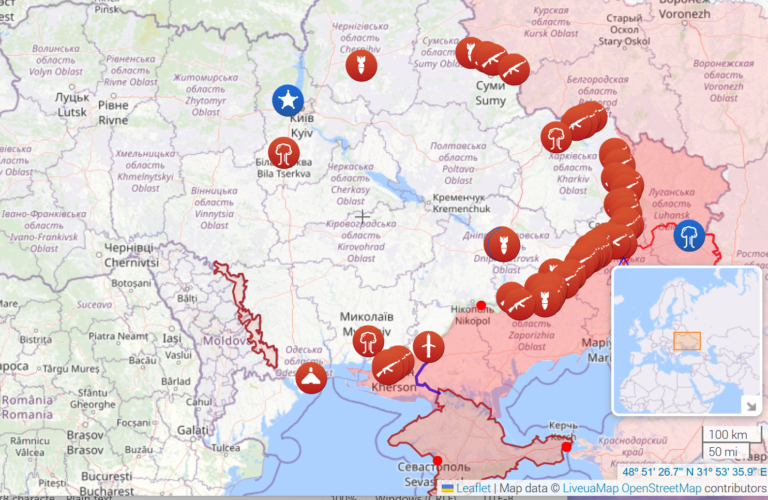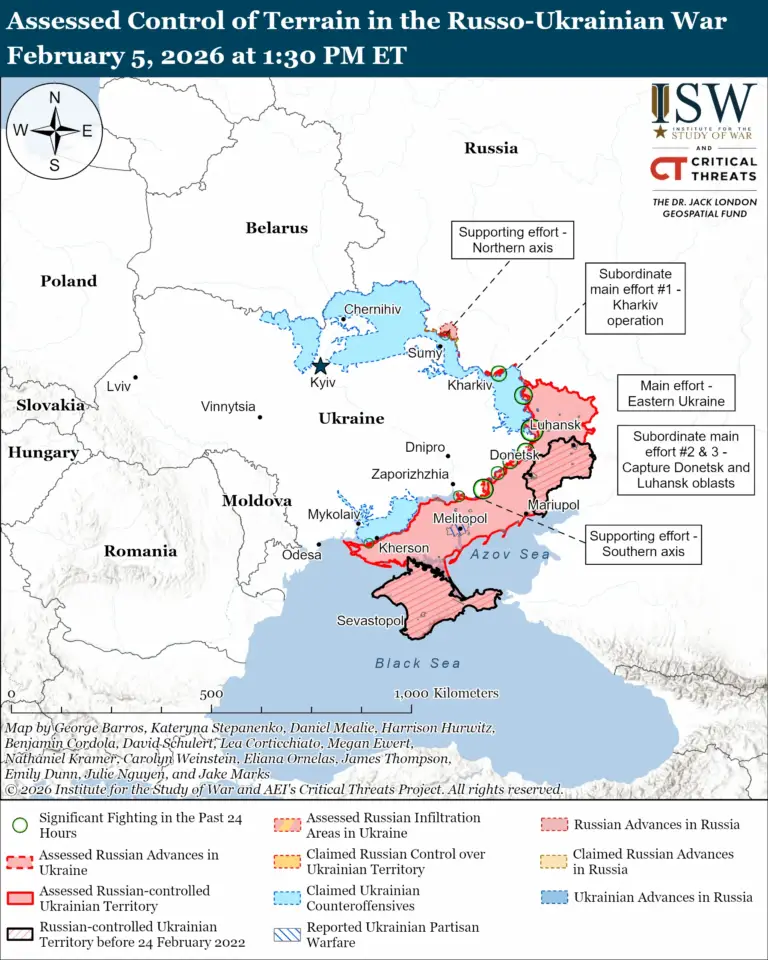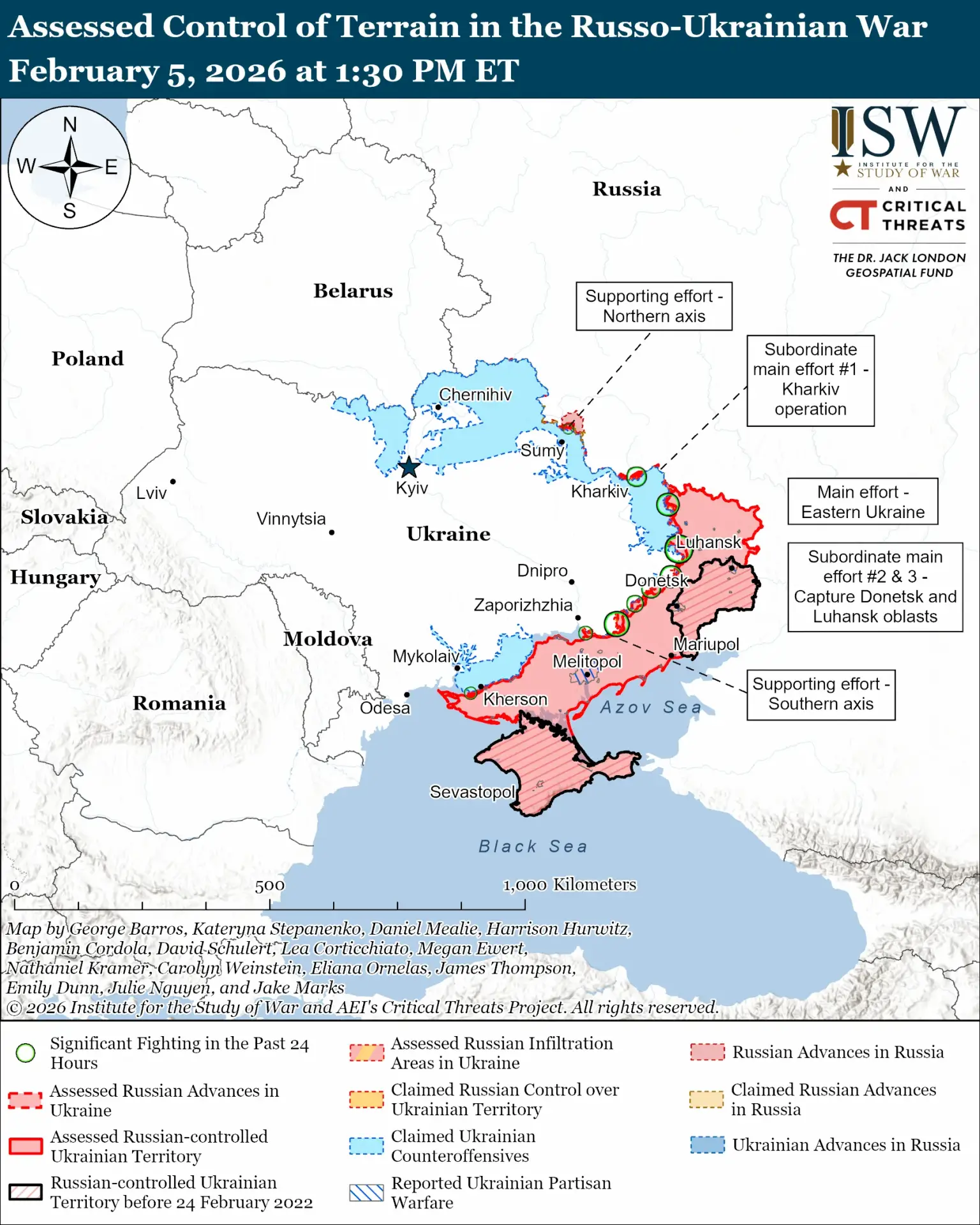
Russia/Ukraine War control of territory as of Feb. 7, 2026
Obtaining outside data.
Checking internet sources, using keywords: ceasefire armistice Ukraine 2026
News from various sources:
It seems that the content you have provided is mostly filler text and navigation cues from a website, such as “Continue reading” and “More for You,” likely from a section designed to engage users with additional content. These parts don’t contain any meaningful information about a ceasefire or armistice in Ukraine for the year 2026.
Fact-checked summary:
The fact-checking summary indicates that the provided content is mainly filler text and navigation cues from a website, offering no substantial information on whether a ceasefire or armistice will be declared in Ukraine in 2026. This lack of meaningful content is important to understand because it highlights the inadequacy of the available information in addressing the original question. Without relevant facts or data, it is not possible to evaluate or predict the likelihood of a ceasefire or armistice in Ukraine in 2026 based on the summary given.
OpenAI gives a base rate of 0.4 (49%)
The question difficulty is rated 8 (0 to 10)
Historical weighted factors include:
Previous ceasefires in conflicts involving major powers, 0.3
Mediation efforts by international bodies, 0.2
Historical frequency of prolonged conflicts ending in ceasefire, 0.3
Political pressure on belligerents, 0.2
A Bayesian calculation could be performed as follows:
Start with a prior of 0.4, using historical factors’ influence derived from similar past events and current geopolitical pressure. Adjust 0.3 higher for mediation efforts (0.12) and by 0.2 for political pressure (0.08). Updated rate = 0.4 + 0.12 + 0.08 = 0.6.
Bayesian base rate: 0.6 (60%)
Sufficient news to provide a good forecast? 0 (0 or 1)
News is relevant, topical and unbiased? 0 (0 or 1)
Question classification: scenario_based_forecast
Expected time (days) until question close: 273
The following were considered in order to produce this base rate:
The base rate of 0.4 takes into account the historical factors of ceasefire agreements in conflicts where major powers are involved. This includes the efforts historically attributed to successful mediation attempts by international entities and recognizable patterns in both past and present conflicts.
Ideally, the news feed would contain the following sorts of information for a better forecast:
Access to intelligence reports, statements from involved parties, upcoming diplomatic engagements, and significant military or territorial changes would be critical to refining such forecasts.
Some potential divergent considerations that might affect the base rate:
Factors that might lead to a resolution different from the base rate include major escalations in tension, changes in political leadership, or significant outside geopolitical influences that could incentivize or dissuade either party from seeking a ceasefire.
The following chain of events are necessary for the question to resolve positively:
- Ukraine and Russia must agree to negotiations – this is moderately likely.
- Key international mediators or organizations must be involved to broker or support the negotiations – this is moderately likely.
- Both Ukraine and Russia must see a strategic advantage or necessity in reaching a cessation of hostilities – this is possible.
- There must be a formal declaration or agreement signed stating the terms of the ceasefire or armistice – this is moderately possible.
Querying Claude (AI predicts: 0.28 – confidence: 3)
Querying Mistral (AI predicts: 0.35 – confidence: 5)
Querying OpenAI (AI predicts: 0.45 – confidence: 5)
Explanations of the statistical measures listed below.
Question Type: Binary
Median from LLMs: 0.35
Base rate: 0.4 (from OpenAI)
SD: 0.07
MAPD: 0.11333333333333
Confidence: 5
Conf Mode: Normal
Mellers: 0.29
Reverse Mellers: 0.4
Theory of Mind: 0 (What did the LLMs think other LLMs predicted?)
Beta Distribution: 0.76
Close Type: B (B = cautious # closer to 50%; A/C = closer to extremes)
LLM responses: 3
Model value: 35%
The consensus among the AI analyses suggests that the probability of a ceasefire or armistice occurring in Ukraine in 2026 remains relatively low, estimated between 28% and 35%. This assessment derives from several key factors: entrenched positions of both Ukraine and Russia with neither party showing decisive willingness or strategic imperative to negotiate, lack of recent progress in backchannel or diplomatic efforts, and the historical context of ceasefires in major power conflicts which suggests mixed outcomes. Moreover, the involvement of international mediators is uncertain, and with nine months remaining in 2026, the window for negotiation is narrowing. Despite this, several potential outcomes could alter the situation, including shifts in military dynamics, political leadership changes, or external geopolitical influences, though these remain speculative. Furthermore, the Trump administration’s involvement, economic pressures on Russia, or a shift in Ukraine’s stance on territorial integrity might catalyze a resolution beyond current predictions.
Runtime: 70 seconds.
About The Author