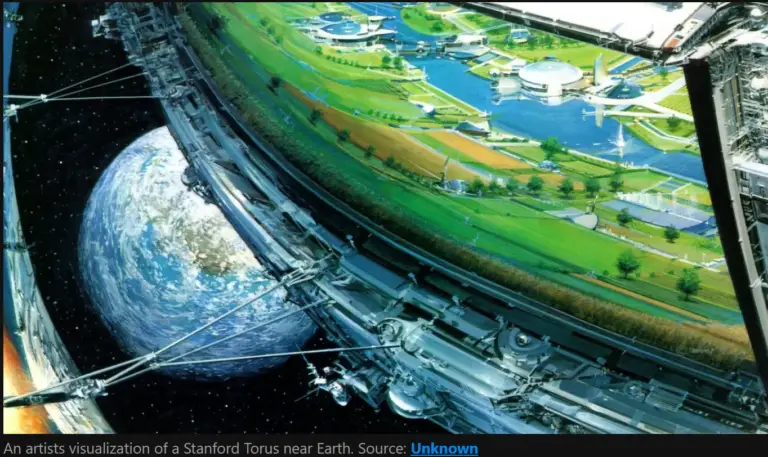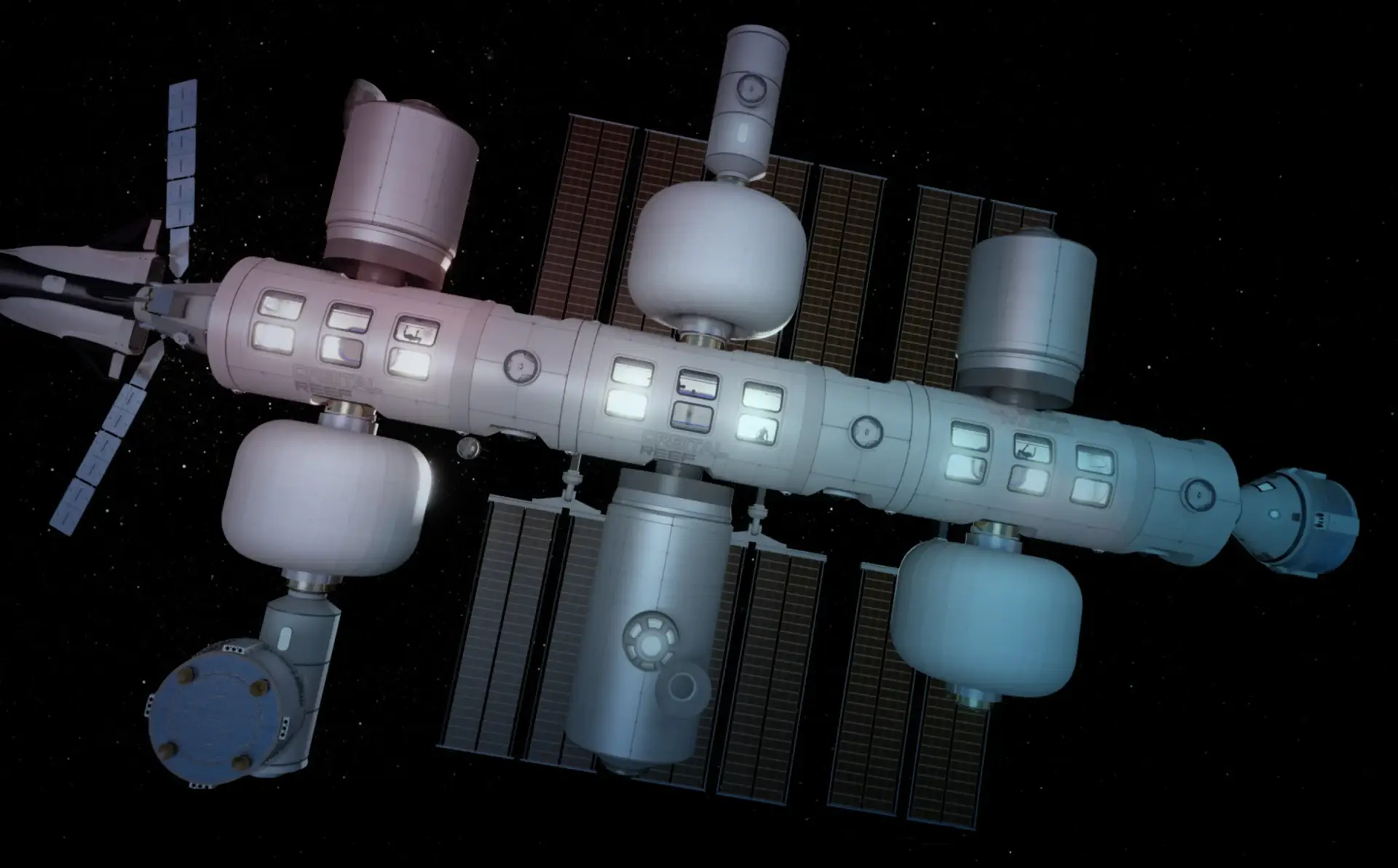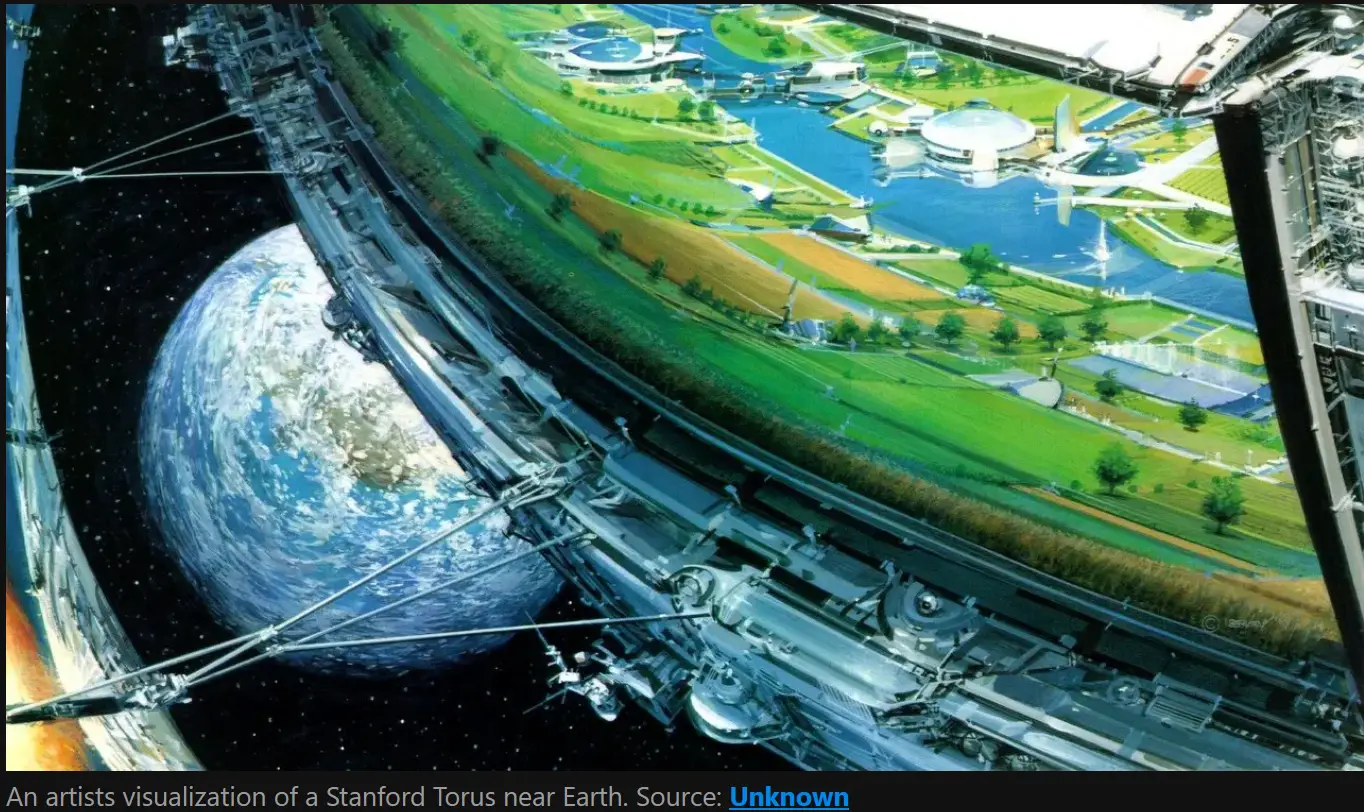
Stanford Torus. Source: Beyond Earth https://www.beyondearth.gg/documentation/space_habitats
Obtaining outside data.
Checking internet sources, using keywords: space habitat human visit 2027
News from various sources:
Max Space, a company focused on innovative space habitats, is establishing a manufacturing facility at the Kennedy Space Center in Florida. Their goal is to create expandable space habitats using materials similar to Kevlar, which are lightweight yet durable, to support NASA’s vision of a human presence on the moon and Mars. The company plans to launch a small-scale demonstration of their habitat technology on a SpaceX Falcon 9 rideshare mission in 2027. This demonstration will test the habitat’s technology under space conditions, including micrometeoroid impact resilience
Max Space’s Thunderbird Station, an expandable habitat capable of hosting up to eight astronauts, is slated for launch as early as 2029. The company’s innovative approach allows quick manufacturing and adaptability to different environments without redesign, positioning them to support future missions beyond Earth’s orbit to moon and Mars. The Thunderbird Station will be launched in a single Falcon 9 flight, optimizing cost and accessibility. Nicole Stott, a retired NASA astronaut, highlights the potential of these habitats to facilitate human exploration by providing flexible, expandable living spaces on the Moon and beyond.
Max Space’s efforts are closely aligned with NASA’s long-term aspirations to maintain a continuous human presence in low Earth orbit and advance microgravity research. The technology and infrastructure developed by Max Space could also play a crucial role in exploring natural protective environments, like lunar lava tubes, providing additional radiation and impact protection for astronauts.
Fact-checked summary:
Max Space is actively working towards developing new space habitats that could potentially be visited by humans before the end of 2027. They are establishing a manufacturing facility at the Kennedy Space Center in Florida to produce expandable space habitats using advanced materials, which is an important step in their preparations. Plans are in place for a demonstration of their habitat technology on a SpaceX Falcon 9 rideshare mission in 2027, which will test the habitat’s resilience under space conditions, including micrometeoroid impacts. This demonstration is an important precursor to potential human visitation. Max Space’s quick manufacturing approach and adaptability of habitats further support the likelihood of an earlier human visit. Additionally, Max Space’s efforts align well with NASA’s aspirations for maintaining a continuous human presence in low Earth orbit, which is significant in expediting timelines for human visitation.
OpenAI gives a base rate of 0.3 (30%)
The question difficulty is rated 7 (0 to 10)
Historical weighted factors include:
Precedent of commercial collaboration with NASA, 0.3
Track record of space technology companies in meeting deadlines, 0.3
Development and testing success of new space technologies, 0.4
A Bayesian calculation could be performed as follows:
Using current progress indicators and historical factors: P(Aligned with NASA) = 0.6; P(Successful tech deployment) = 0.7; P(Human visit readiness) = 0.4. Bayesian update gives P(Human visit by 2027 | evidence) = 0.3 * 0.6 + 0.3 * 0.7 + 0.4 * 0.4 = 0.54. (Carolyn‘s note: I get 0.55 whether I calculate it like this:
=0.3*0.6+0.3*0.7+0.4*0.4 or this: =(0.30.6)+(0.30.7)+(0.4*0.4) )
Bayesian base rate: 0.54 (54%)
Sufficient news to provide a good forecast? 1 (0 or 1)
News is relevant, topical and unbiased? 1 (0 or 1)
Question classification: scenario_based_forecast
Expected time (days) until question close: 640
The following were considered in order to produce this base rate:
To determine the base rate, I examined previous examples of space technology deployments and alignments with NASA’s objectives. Considering the necessity of technological success and regulatory approvals, historical data suggests a moderate base rate due to typical delays and regulatory challenges.
Ideally, the news feed would contain the following sorts of information for a better forecast:
Additional information on NASA’s prioritization of the project, including funding levels and political climate regarding space exploration, would refine the forecast. Insights into competing projects and technological developments would also be useful.
Some potential divergent considerations that might affect the base rate:
Rapid advancements in technology and accelerated processes in recent years could outperform historical trends. If Max Space can leverage novel materials and quick manufacturing, timelines might be expedited. Furthermore, strong industry push or national priorities might accelerate regulatory processes.
The following chain of events are necessary for the question to resolve positively:
- Successful establishment and functioning of Max Space’s manufacturing facility at the Kennedy Space Center by 2027. Likelihood: Highly likely.
- Completion and successful deployment of Max Space’s expandable space habitat using advanced materials. Likelihood: Likely.
- Successful launch and demonstration of the habitat on a SpaceX Falcon 9 mission in 2027, testing resilience to space conditions. Likelihood: Likely.
- Alignment of Max Space’s projects with NASA’s objectives for continuous human presence, leading to collaboration or support. Likelihood: Likely.
- Approval from regulatory bodies for human visits to new space habitats by the end of 2027. Likelihood: Moderately likely.
Querying Claude (AI predicts: 0.15 – confidence: 6)
Querying Mistral (AI predicts: 0.65 – confidence: 7)
Querying OpenAI (AI predicts: 0.65 – confidence: 7)
Explanations of the statistical measures listed below.
Question Type: Binary
Median from LLMs: 0.65
Base rate: 0.3 (from OpenAI)
SD: 0.24
MAPD: 0.33333333333333
Confidence: 7
Conf Mode: Low
Mellers: 0.71
Reverse Mellers: 0.6
Theory of Mind: 0.35 (What did the LLMs think other LLMs predicted?)
Beta Distribution: 0.05
Close Type: C (B = cautious # closer to 50%; A/C = closer to extremes)
LLM responses: 3
Model value: 65%
The various AI analyses converge on a cautious skepticism about the likelihood of a new space habitat being visited by humans by the end of 2027, largely due to historical precedents of delays in space projects, stringent regulatory requirements, and the compressed timeline of just 21 months. While there are grounds for optimism due to advancements in technology, such as those made by Max Space and its alignment with NASA’s objectives, they are tempered by the realities of regulatory hurdles, untested technologies at scale, and the absence of publicly announced concrete crewed mission plans. Though theoretical accelerated paths exist—such as through unforeseen announcements, the streamlining of regulatory processes, or technological leaps—the overall assessment remains that potential challenges could push human visitation beyond the projected deadline.
Runtime: 115 seconds.
About The Author