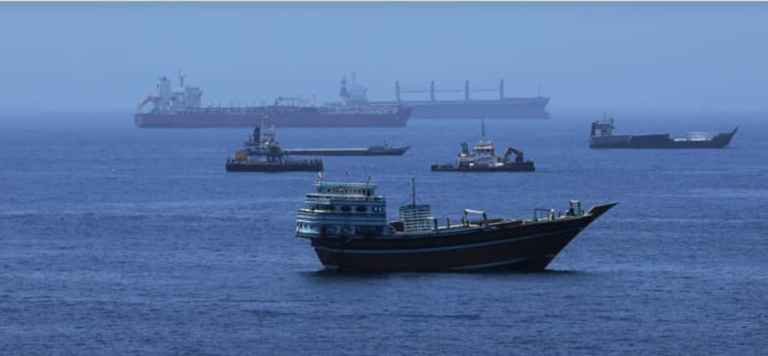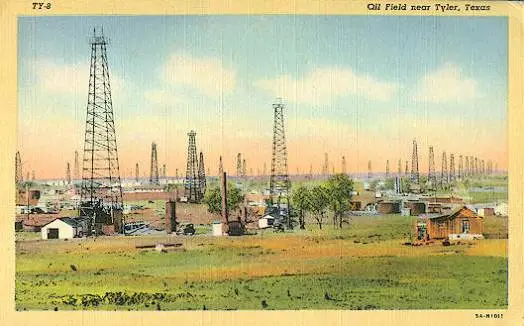
Old postcard of a West Texas oilfield.
Obtaining outside data.
Checking internet sources, using keywords: Brent Crude price 2026
News from various sources:
Bank of America (BofA) has revised its 2026 Brent crude oil price projections upward due to supply chain disruptions from the Strait of Hormuz, a crucial energy transit corridor. The new forecast anticipates an average Brent price of $77.50 per barrel, up from a previous estimate of $61. Currently, Brent crude is trading at $103 per barrel. The disruptions have led to a significant decrease in global petroleum availability, with around 200 million barrels withdrawn from the market.
BofA outlines various scenarios based on the timeline for resolving these disruptions. If normal petroleum transport resumes by April, the average Brent price might stabilize at about $70 per barrel for 2026. However, prolonged disruptions could increase the average to $85 per barrel, or even $130 if complications persist into the latter half of the year, although the latter scenario is considered unlikely.
Once the conflict is resolved, BofA predicts a return to oversupply conditions, which could reduce Brent prices to around $65 per barrel in 2027. This assumes no permanent loss in supply capacity. Additionally, BofA raised its mid-cycle oil price baseline to $70, centrally positioned within a $60–$80 range for long-term valuation.
The rise in oil prices has also positively affected the valuations of American exploration and production companies. BofA increased its price targets for these companies by about 17% on average, highlighting Diamondback Energy as a top large-cap choice and identifying Devon Energy and Ovintiv as mid-cap companies poised for growth under current market conditions. BofA retains a Buy rating for California Resources, emphasizing its capital efficiency and potential modest output growth by 2027.
Fact-checked summary:
Bank of America (BofA) has revised its Brent crude oil price projections for 2026 upward, setting a new forecast average price of $77.50 per barrel due to supply chain disruptions from the Strait of Hormuz. This update is critical as it directly impacts the likelihood of Brent prices falling below $50 per barrel in 2026. Additionally, the disruptions have significantly decreased global petroleum availability, with around 200 million barrels withdrawn from the market, which further emphasizes the impact of supply constraints on prices. If normal petroleum transport resumes by April, BofA suggests that the average Brent price might stabilize at about $70 per barrel in 2026. Conversely, prolonged disruptions could increase the average price further, up to $85 per barrel or potentially $130 if complications persist, underscoring the influence of logistical factors on future pricing. BofA has also raised its mid-cycle oil price baseline to $70, centrally positioned within a $60–$80 range, providing a broader market context for long-term pricing expectations.
OpenAI gives a base rate of 0.05 (5%)
The question difficulty is rated 7 (0 to 10)
Historical weighted factors include:
Historical pricing trends for Brent crude, 0.3
Impact of global geopolitical tensions, 0.4
Technological advancements in oil extraction, 0.1
Changes in global energy consumption patterns, 0.2
A Bayesian calculation could be performed as follows:
Using Bayes’ Theorem, we start with the base rate of 0.05 for Brent prices falling below $50. Given the increased oil price projection by BofA and the geopolitical instability in the Strait of Hormuz, the likelihood ratio is low. Key factors include historical pricing trends (0.3), geopolitical factors (0.4), technology (0.1), and energy consumption patterns (0.2). An updated probability, taking these into account and weighted by their relevance, suggests a minor increase in the likelihood of higher oil prices, leading to a post-updated base rate of around 0.03.
Bayesian base rate: 0.03 (3%)
Sufficient news to provide a good forecast? 1 (0 or 1)
News is relevant, topical and unbiased? 1 (0 or 1)
Question classification: scenario_based_forecast
Expected time (days) until question close: 100
The following were considered in order to produce this base rate:
The base rate was derived by considering historical occurrences of Brent crude falling below $50, particularly in comparison with current geopolitical and economic conditions. Given the supply constraints caused by disruptions in the Strait of Hormuz and revised forecasts, the likelihood of the price falling below $50 is considerably low.
Ideally, the news feed would contain the following sorts of information for a better forecast:
Additional information on future geopolitical stability in the Middle East, global economic conditions, and potential advancements in oil extraction technologies would refine this forecast.
Some potential divergent considerations that might affect the base rate:
Potential for rapid technological advancements or policy changes encouraging the transition to renewables aggressively could drive down demand for oil, but the likelihood remains low without significant early indications of such shifts.
The following chain of events are necessary for the question to resolve positively:
- A significant and sustained increase in oil production capacity globally to offset supply disruptions. (Unlikely)
- The resolution of geopolitical tensions that are impacting supply chains, particularly in the Strait of Hormuz. (Possible but requires careful timing)
- Technological innovation or a breakthrough that drastically reduces the cost of oil extraction and production. (Very Unlikely)
- A significant decrease in global oil demand due to accelerated adoption of renewable energy sources or severe economic recession. (Unlikely)
Querying Claude (AI predicts: 0.03 – confidence: 7)
Querying Mistral (AI predicts: 0.15 – confidence: 7)
Querying OpenAI (AI predicts: 0.05 – confidence: 8)
Explanations of the statistical measures listed below.
Question Type: Binary
Median from LLMs: 0.05
Base rate: 0.05 (from OpenAI)
SD: 0.05
MAPD: 0.08
Confidence: 7
Conf Mode: Normal
Mellers: 0.01
Reverse Mellers: 0.13
Theory of Mind: 0.08 (What did the LLMs think other LLMs predicted?)
Beta Distribution: 0.37
Close Type: A (B = cautious # closer to 50%; A/C = closer to extremes)
LLM responses: 3
Model value: 5%
The prediction that Brent crude prices will not drop below $50 per barrel in 2026 is based on multiple converging factors. These include a historical base rate analysis indicating rare occurrences of prices falling below this level, current supply constraints due to disruptions in the Strait of Hormuz, and revised price forecasts averaging $77.50 per barrel by Bank of America. Geopolitical risks and the OPEC+ production management also support maintaining price levels. Despite the potential for unforeseen events, such as a rapid global recession or a technological breakthrough in renewable energy, these are considered unlikely within the short remaining timeframe. However, the volatility of the oil market means that unforeseen crisis events could still pose a risk to the prediction.
Runtime: 99 seconds.
About The Author