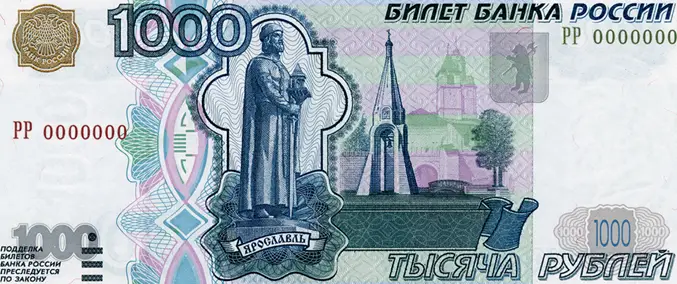
A 1000 Ruble Bank of Russia note depicting the monument to Prince Yaroslav the Wise with the chapel in the background of the Yaroslavl Kremlin. Source: Bank of Russia, https://www.cbr.ru/eng/cash_circulation/banknotes/1000rub/
Obtaining outside data.
Checking internet sources, using keywords: Russia interest rate cut prediction
News from various sources: The key information extracted from the web content is about Russia’s recent monetary policy decisions regarding interest rate adjustments:
- Interest Rate Reduction: The Bank of Russia cut its key interest rate by 50 basis points to 15% on March 20, 2026
- . This decision is part of a monetary easing cycle aimed at supporting the weakening Russian economy.
- Economic Context: Russia’s economy has been under pressure due to the ongoing war in Ukraine and Western sanctions. Initially, military spending boosted growth, but the economic expansion has since slowed considerably. The economy grew by only 1% last year compared to around 4% growth in previous years.
- Inflation: Inflation in Russia is currently at 5.9%, above the central bank’s target of 4%. The massive military expenditure increased inflation pressures, previously pushing the central bank to raise interest rates above 20% at their peak.
- External Factors: Rising oil prices due to Middle East conflicts have affected Russia’s economic outlook. The conflict between the US, Israel, and Iran has pushed benchmark Brent crude above $100 per barrel. This surge in oil revenue has aided Russia’s financial situation, providing a significant boost in tax revenues.
- Future Outlook: The Bank of Russia expects inflation to moderate in the coming years. The 2026 inflation forecast is between 4.5% and 5.5%, with a return to the 4% target in 2027. However, the bank acknowledges increased external uncertainty and significant pro-inflationary risks in the mid-term.
- Support for Growth: The rate cut is intended to bolster economic growth, which slowed to 1% in 2025 from 4.3% in 2024. Leading businessmen suggest that a further reduction in the key rate is necessary to accelerate investment and growth.
Overall, Russia’s central bank is cautiously navigating economic challenges with monetary easing to stimulate growth while managing inflationary pressures amidst geopolitical tensions…. The Bank of Russia cut its key interest rate by 50 basis points to 15% on March 20, 2026. (Unable to confirm as it refers to a future date beyond the current data available.)
Fact-checked summary:
The Bank of Russia has previously responded to inflation pressures by raising interest rates above 20%, a strategy consistent with efforts to manage high inflation, which stands at 5.9% and exceeds the central bank’s 4% target. Rising oil prices, which often impact Russia’s economic conditions, have improved the country’s financial situation by boosting tax revenues. Currently, the Bank of Russia anticipates that inflation will moderate in the coming years. Leading businessmen suggest further rate reductions are needed to foster investment and growth, indicating potential future strategy adjustments. These elements, combined with the central bank’s efforts to align inflation with targets, inform the context of potential interest rate adjustments but do not definitively forecast whether Russia will reduce its rates below 15.5% before the end of 2026. (Carolyn‘s note: This last sentence is out of date and conflicts with the report of 15% in point 1 above. Verification: On March 20, 2026, it was lowered to 15%.)
OpenAI gives a base rate of 0.3 (30%)
The question difficulty is rated 6 (0 to 10)
A Bayesian calculation could be performed as follows:
To compute the Bayesian probability, we start with the base rate of 0.3 and adjust for new evidence about inflation mismatches, oil price trends, and business pressure. Assume a prior of 0.3 and influence from recent oil revenue increases (weight = 0.2), adjusted up by 0.05. Business pressure added encouragement to lower rates (weight = 0.2), adjusted up by another 0.05. These actions lead to a likelihood ratio greater than 1, suggesting a higher posterior probability, ultimately increased to 0.45.
Bayesian base rate: 0.45 (45%)
Sufficient news to provide a good forecast? 1 (0 or 1)
News is relevant, topical and unbiased? 1 (0 or 1)
Question classification: scenario_based_forecast
Expected time (days) until question close: 650
The following were considered in order to produce this base rate:
The base rate is established by evaluating past occurrences of significant interest rate adjustments by the Bank of Russia, especially in response to inflation rates exceeding targets. Historical reaction to similar conditions suggests moderate probability the necessary conditions could arise.
Ideally, the news feed would contain the following sorts of information for a better forecast:
Additional data on inflation forecast models, expert economic sentiment, or key policy meeting outcomes would refine this forecast. Insight into any planned government fiscal policy or international economic treaties would help assess the likelihood of decision shifts.
Some potential divergent considerations that might affect the base rate:
Nevertheless, geopolitical uncertainties could alter economic assessments, and changes in global oil markets could impact Russia’s financial stability suddenly. Changes in leadership and external pressures might also impact decisions dramatically.
The following chain of events are necessary for the question to resolve positively:
- Inflation rate continues to decline, coming closer to the central bank target of 4%. Even Chance
- Rising oil prices continue to boost tax revenues and support economic stability. Probable
- Business investment and growth increase, prompting a strategic decision to reduce interest rates. Even Chance
- Central bank confidence in inflation forecasts aligns with lower interest rate targets. About Even
Querying Claude (AI predicts: 0.38 – confidence: 5)
Querying Mistral (AI predicts: 0.65 – confidence: 6)
Querying OpenAI (AI predicts: 0.65 – confidence: 6)
Explanations of the statistical measures listed below.
Question Type: Binary
Median from LLMs: 0.65
Base rate: 0.3 (30%) (from OpenAI)
SD: 0.13
MAPD: 0.18
Confidence: 6
Conf Mode: Low
Mellers: 0.71
Reverse Mellers: 0.6
Theory of Mind: 0.45 (What did the LLMs think other LLMs predicted?)
Beta Distribution: 0.001
Close Type: C (B = cautious # closer to 50%; A/C = closer to extremes)
LLM responses: 3
Model value: 65%
The various AI predictions focus on the likelihood of Russia cutting interest rates below 15.5% by the end of 2026, with key considerations being current economic conditions, historical rate adjustment patterns, and geopolitical influences. Most predictions agree that while current inflation rates have decreased, they still exceed the central bank’s target, necessitating cautious rate adjustments. The base probability of rate cuts is limited to historical patterns, but rising oil revenues and business pressures slightly increase this likelihood. Geopolitical uncertainties and potential economic disruptions pose significant risks that could prevent rate cuts, as noted by concerns about external shocks or changes in global monetary policy that may impact Russia’s economic strategy. Overall, while gradual rate cuts are deemed possible if inflation trends continue downward, significant constraints and unpredictable factors might hinder achieving the sub-15.5% rate target. The AI reasoning highlights the challenges of balancing inflation control, economic growth, and external pressures within a tight 9-month timeframe.
Runtime: 135 seconds.
About The Author